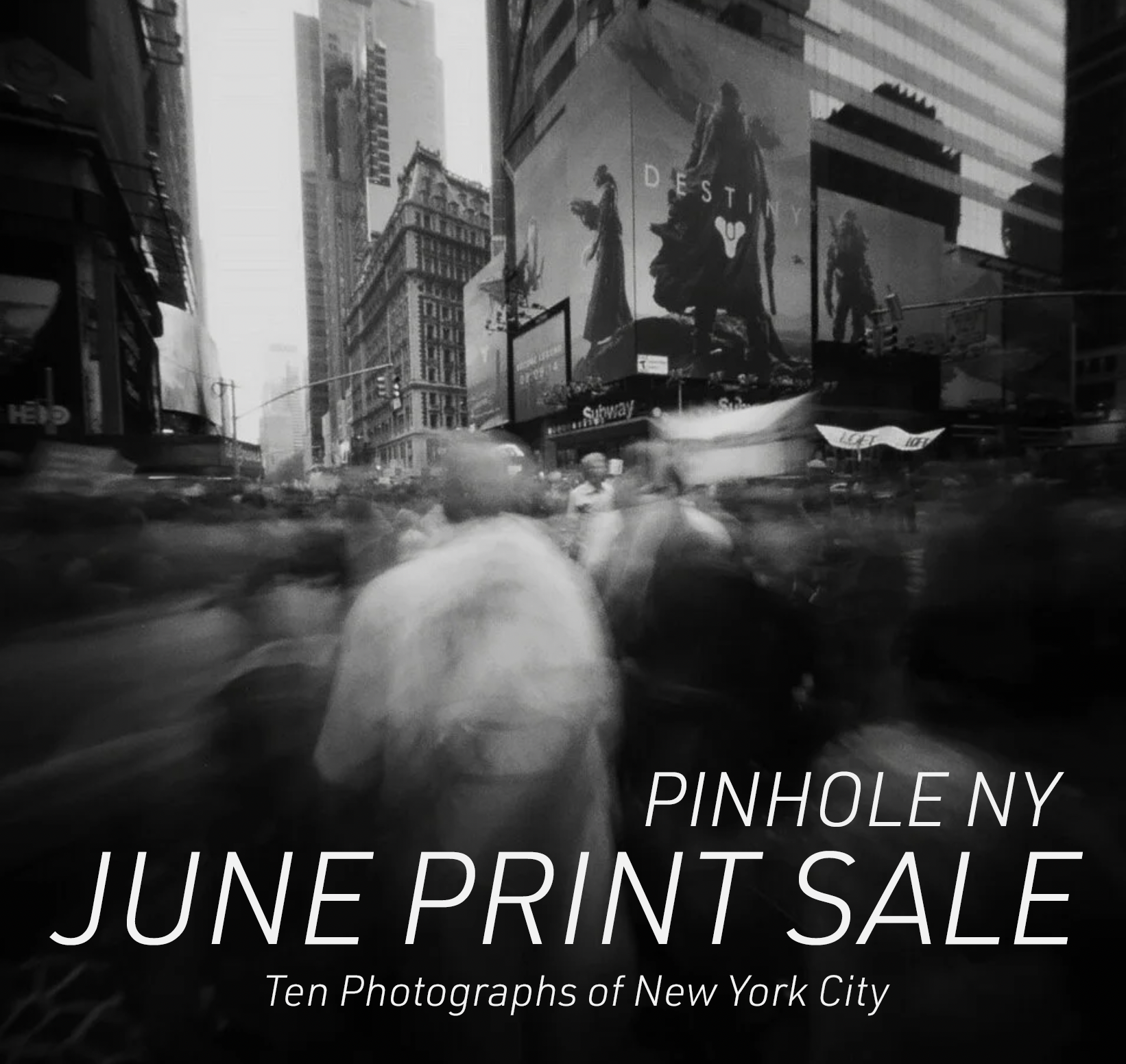
For the month of June, I'm making ten of my New York City pinhole photos available as signed archival prints.
The photographs were made over the last three decades using a handmade, lensless cardboard box camera. Taken on ferries, city streets, beaches, and along the waterfront, they explore time, movement, and the changing life of New York City.
Prints are available in four sizes:
5 × 5 inches — $150
12 × 12 inches — $325
24 × 24 inches — $650
36 × 36 inches — $1200
Order by June 15 and receive 10% off any print size using the code PINHOLE10.
Click below on VIEW AVAILABLE PRINTS to place an order, or scroll further down for the stories behind the photographs.
Thank you for your interest in the work.
—Stefan
Background stories on the ten photographs:

Destiny, 2014
In September 2014, more than 300,000 people filled the streets of New York City for the People's Climate March, one of the largest climate demonstrations in history. I spent the afternoon walking through the crowds with my pinhole camera, making long exposures whenever the movement, light, and energy felt right.
Towards the end of the day I set up my tripod as people walked through Times Square. Because the photograph required several seconds to record, the moving figures dissolved into ghostlike forms while the buildings and billboards remained stable. When the negative came back from the lab, one detail immediately caught my attention: the giant billboard in the background displaying the word "DESTINY."
I hadn't noticed it while taking the photograph.

Times Square, 2014
I love photographing with a pinhole camera in places like Times Square. There is so much happening at once—people moving in every direction, towering architecture, flashing advertisements, deep shadows, bright lights, reflections, weather, chance encounters, words. It’s dramatic and theatrical. The frame is packed with information.
And I love the contrast between the permanence of the city and the movement of people. Buildings remain stable during a long exposure, while people blur, dissolve, and reappear. The contrast makes for beautiful and rich images.
No two exposures are ever the same. Changes in light, movement, timing, or camera position can completely transform the image. That unpredictability is part of what keeps drawing me back. Each photograph feels less like something I manufacture than something I discover.

Climate March, 2014
In September 2014, more than 300,000 people filled the streets of New York City for the People's Climate March, one of the largest climate demonstrations in history. I spent the afternoon walking through the crowds with my pinhole camera, making long exposures whenever the movement, light, and energy felt right.
Most of the photographs I made that day emphasize the scale of the march—the collective movement of people through the city. But standing in the middle of the Avenue of the Americas, surrounded by towers of glass and steel, one woman emerges from the march, remaining still just long enough to leave a recognizable presence on the film.
There is a small GAP sign visible at the edge of the photograph. I didn't notice it when I made the exposure, but I've come to appreciate it. The word seems to echo the contrast in the image — a lone figure in one of the world's great corporate corridors. One voice against a backdrop of institutions, wealth, and power.

Jane's Carousel, 2014
Jane’s Carousel was a fitting subject for my Pinhole NY project—a years-long meditation on time and space using a lensless cardboard box camera. But beyond the obvious metaphor, which Joni Mitchell captured so beautifully in “The Circle Game”, who doesn’t love an old-fashioned carousel and the bright, brassy sound of a band organ?
Built in 1922, the carousel was originally located in Youngstown, Ohio. After the park closed, it was purchased at auction by Jane Walentas, who restored it over 22 years in her Dumbo studio—a stone’s throw from both my own studio and Fulton Ferry Landing, where Walt Whitman’s poem “Crossing Brooklyn Ferry” was born. Today, the carousel lives in a stunning glass pavilion designed by Pritzker Prize–winning architect Jean Nouvel.
When I went to photograph it in 2014, maybe for the third time, I set up my tripod outside the roped-off carousel. My earlier images were decent, but not especially surprising, and I wasn’t sure what I’d do differently this time. Then I remembered something a photographer friend once told me: If your photo isn’t good enough, you’re not close enough. So I bought a few tickets and climbed aboard with my son, Lee. I took about eight exposures—and bingo.
We’re captive on the carousel of time.
Subway, 2012
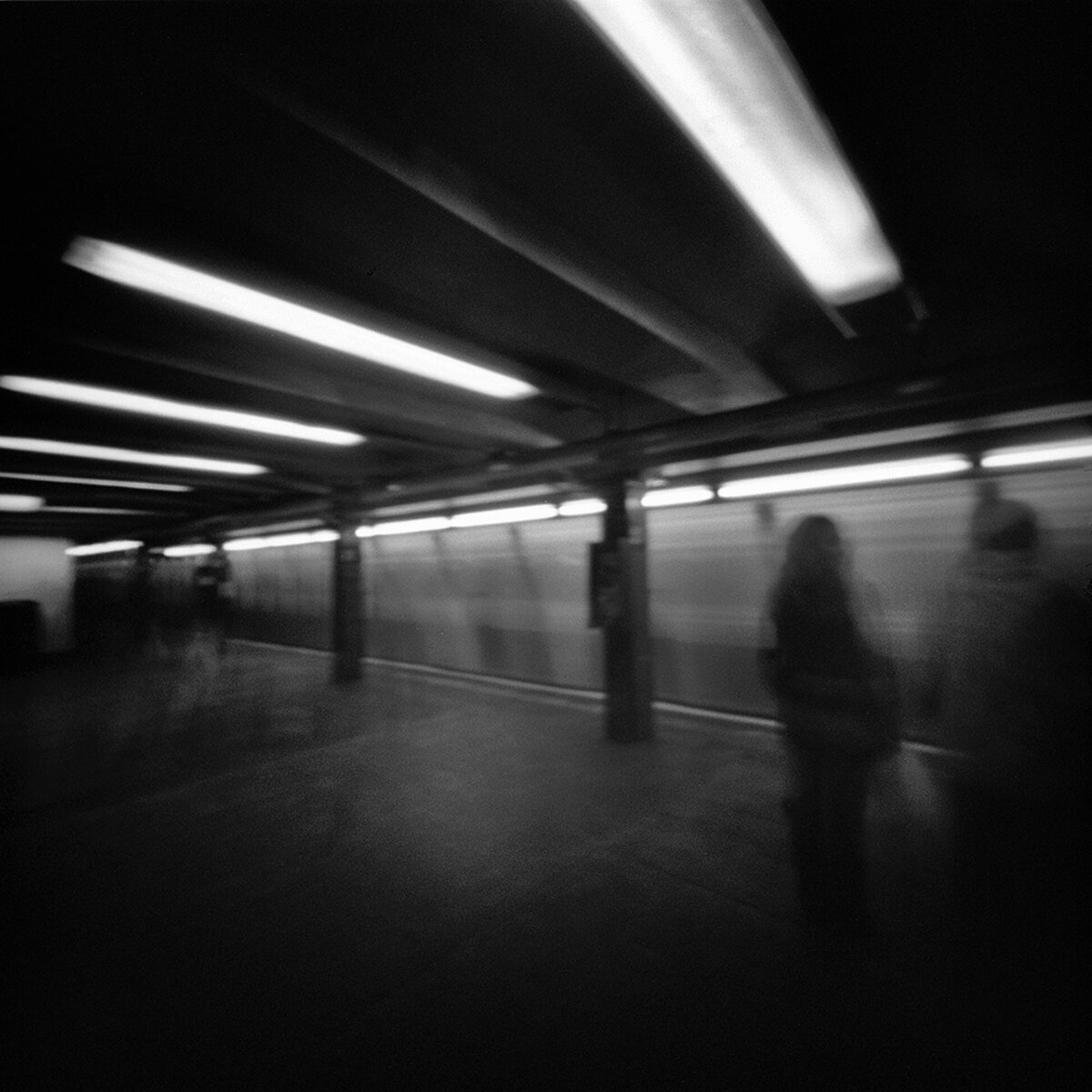
This photograph was made on the uptown platform of the 1/9 train at 23rd Street in Manhattan. The New York subway is a challenging place to photograph with a pinhole camera, mainly because it's so dark. Stations are dimly lit, requiring exposures of at least ten seconds. Trains move quickly, and the constant flow of passengers makes it impossible to predict what will happen during a long exposure.
I love this element of chance in pinhole photography and never feel that I can claim full ownership of a successful image, only that I was attentive and fortunate enough to receive one. Once the aperture is opened, time, light, movement, and space begin interacting in ways I can't fully anticipate or control. Chance becomes an essential part of the process.
There is very little in this photograph that I anticipated. The streaking train, the glowing bands of light, the balance between motion and stillness, even the relationships between the lines and forms in the frame emerged during the exposure itself. I chose the camera position and opened the shutter. The photograph took shape from there.
Governor's Island Ferry, 2014
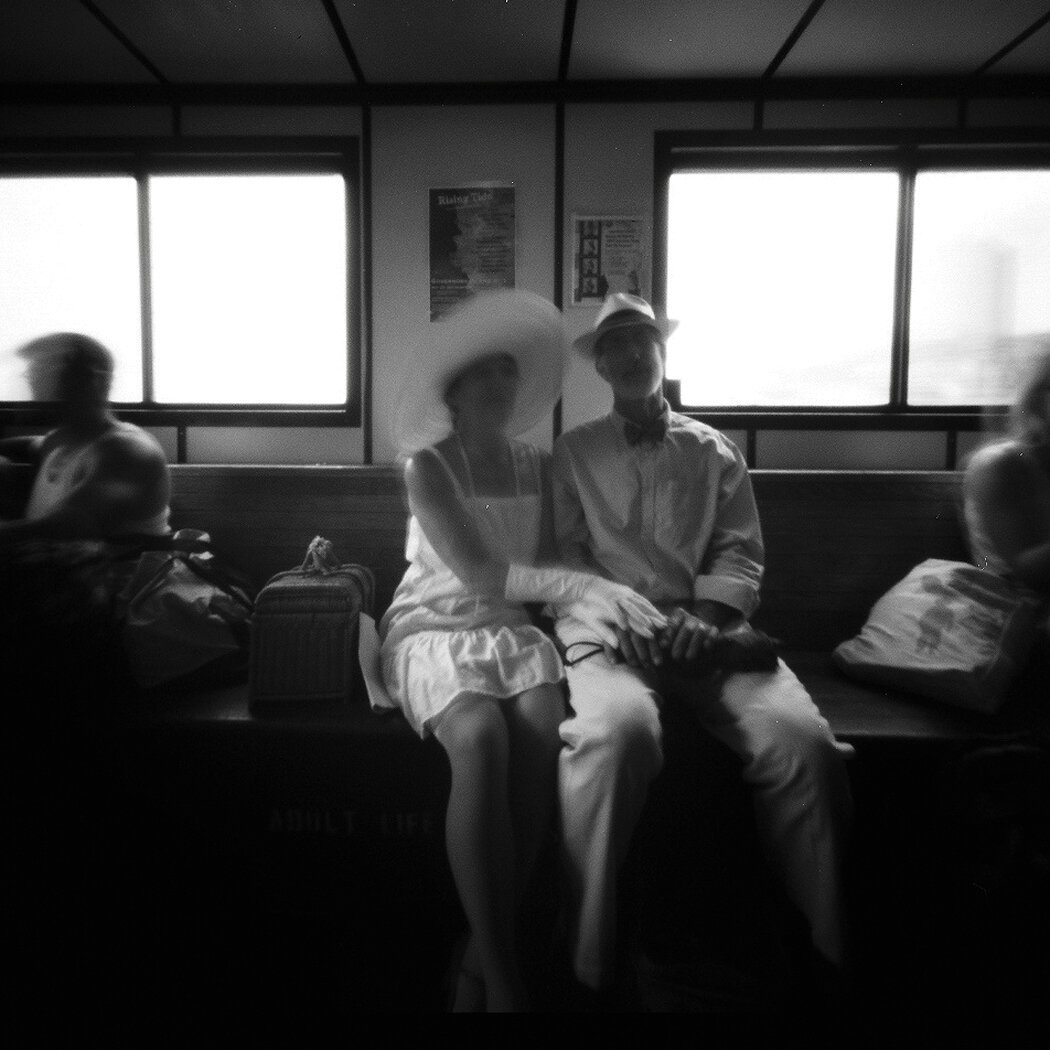
This photograph could easily have been taken in the 1920s, but was made in 2014.
I was on my way to Governor’s island, unaware that thousands of others—dressed in vintage clothing—were headed there as well for the Jazz Age Lawn Party, an annual event celebrating the music, fashion, and culture of the 1920s.
By chance, I happened to know the man seated in the center of the photograph, and asked if I could take a picture of the two of them. I didn't realize it at the time, but when I picked up the developed film, the image immediately reminded me of a passage from Whitman's great poem of time travel, Crossing Brooklyn Ferry:
Crowds of men and women attired in the usual costumes, how curious you are to me!
On the ferry-boats the hundreds and hundreds that cross, returning home, are more curious to me than you suppose.
And you that shall cross from shore to shore years hence are more to me, and more in my meditations, than you might suppose.
— Walt Whitman, Crossing Brooklyn Ferry
Carousel, 2013
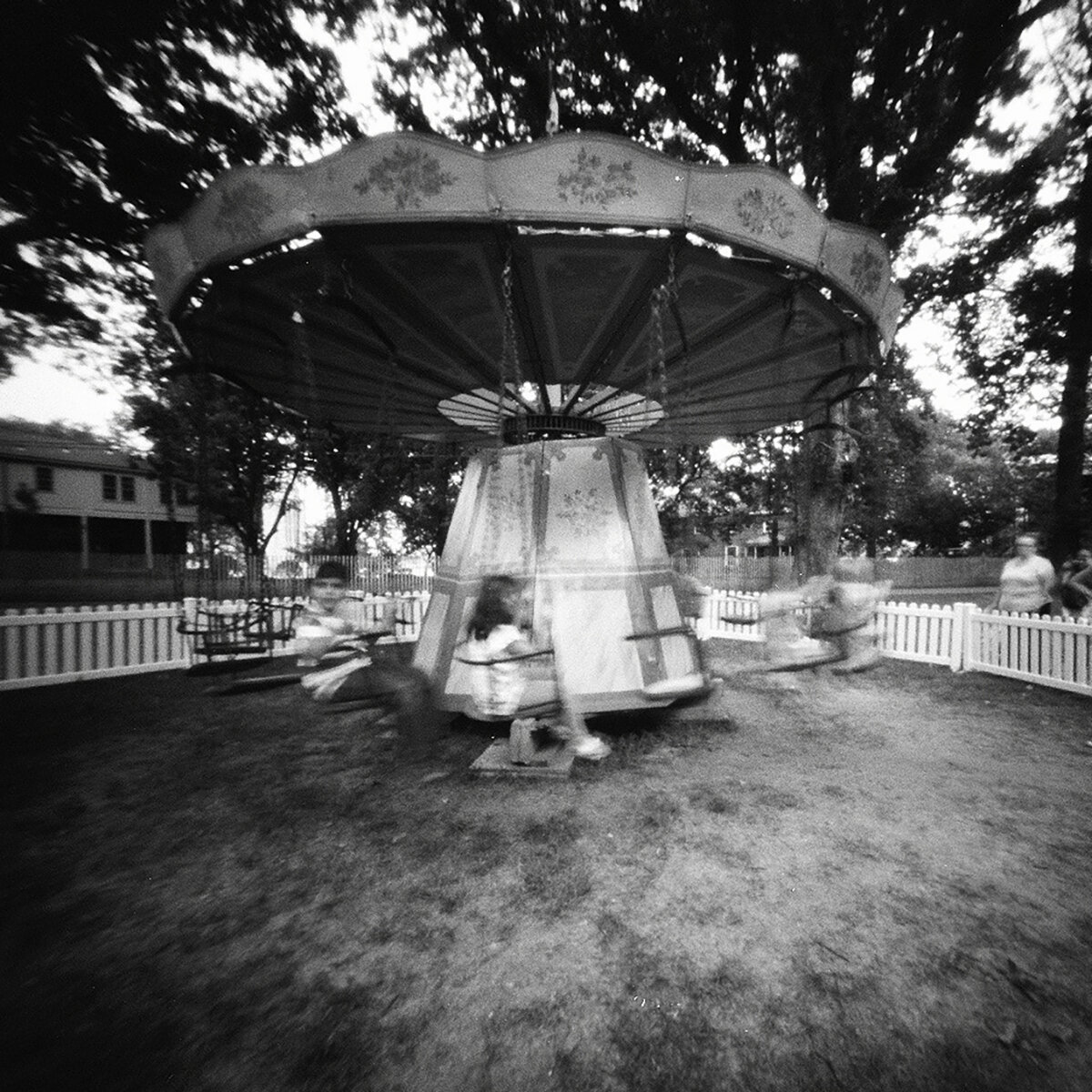
This photograph was made on Governors Island during Fête Paradiso, a temporary exhibition of restored French carnival rides dating from the late nineteenth and early twentieth centuries. I was always looking in the news for events that would be fun to photograph and had read about this exhibition. The idea of a collection of antique carousels was hard to resist.
I love the boy at left looking at the camera—or at someone. The fact that his attention is more on someone else than the carousel—perhaps another mother outside the fenced-off area, like the one at the right side of the frame—and that he seems slightly too old for the carousel, always give me a feeling that he outgrew this ride a few years earlier. Yet there he is, still going round and round with the seasons.

Staten Island Ferry, 2014
This photograph was made on the Staten Island Ferry as it left lower Manhatten. I have no memory of the passenger standing at the railing being headless, but such is the magic of pinhole photography that it reveals these details.
The photograph reminds me of Whitman's “Crossing Brooklyn Ferry,” a poem written more than 150 years ago about the continuity of people, cities, and time.
Just as you feel when you look on the river and sky, so I felt...
Just as any of you is one of a living crowd, I was one of a crowd.
— Walt Whitman, “Crossing Brooklyn Ferry”
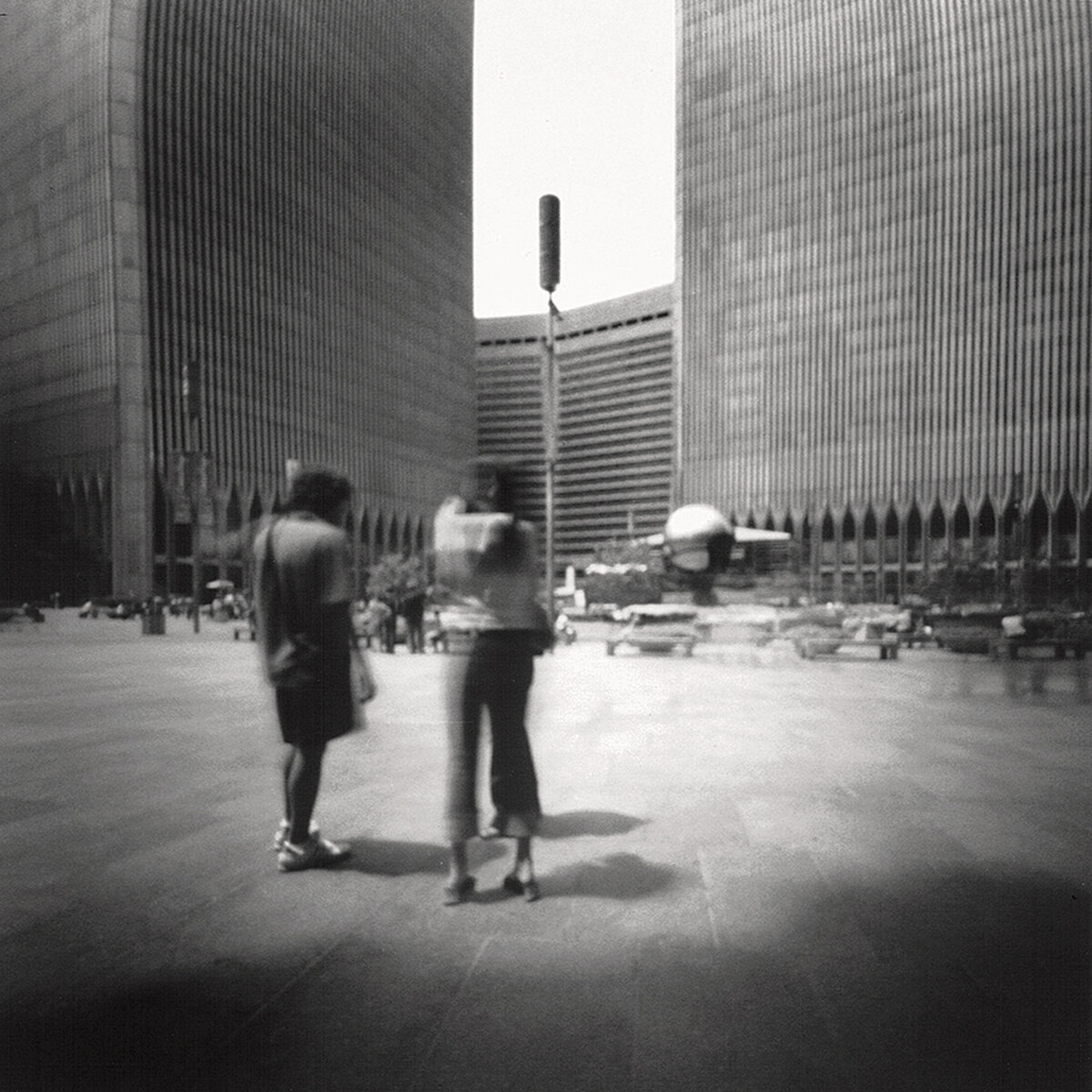
Twin Towers, 2001
I took this photograph of the World Trade Center in August 2001. Only a few weeks later, the towers were gone.
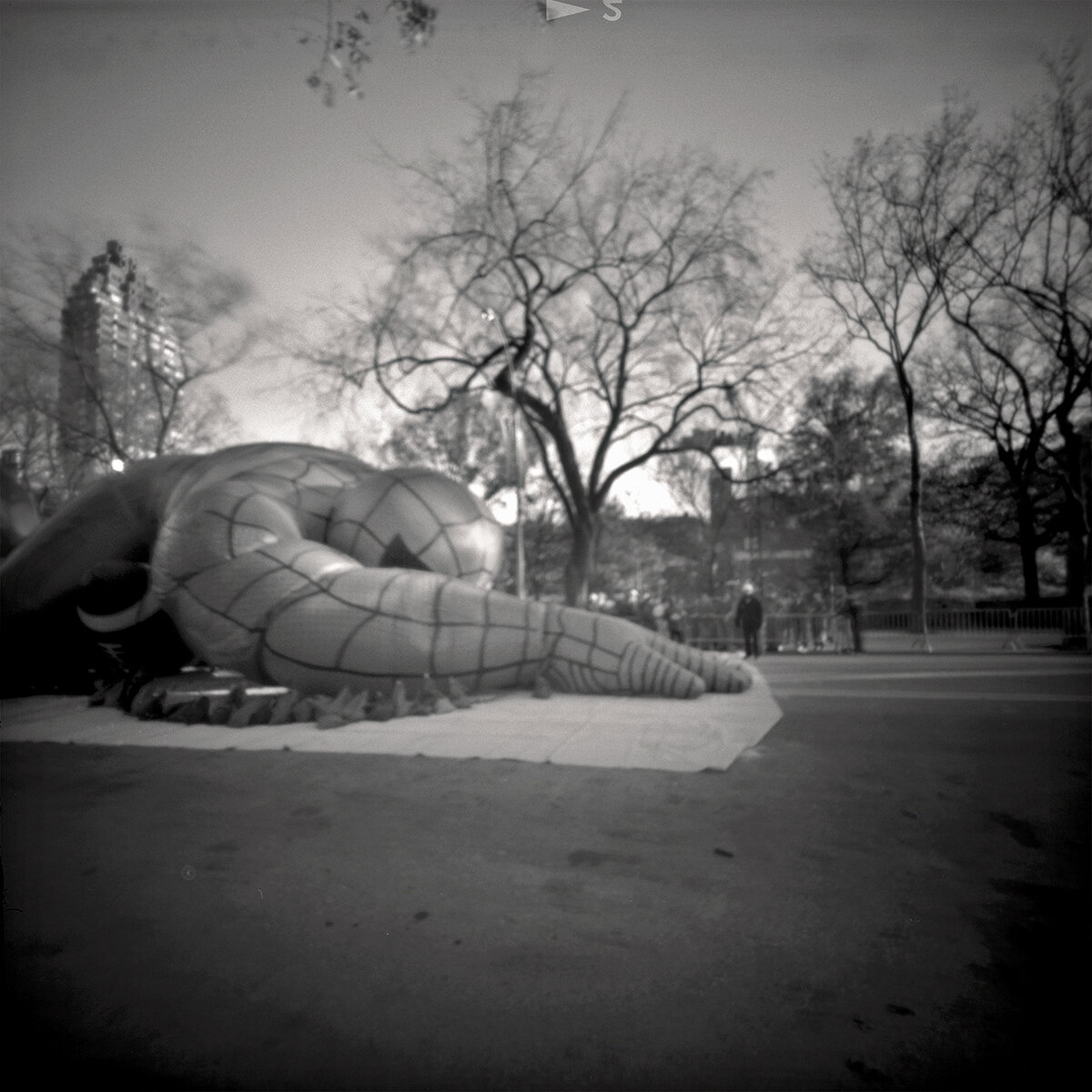
Spiderman, 1995
This photograph was made early on Thanksgiving morning in 1995 during the inflation of the Macy's Thanksgiving Day Parade balloons.
I had gone out with my pinhole camera hoping to photograph the theater of the balloons. One of the things I love about pinhole photography is its ability to transform familiar subjects into something unexpected, and sometimes even poetic. I thought the balloons would make terrific subjects, and I wasn't disappointed.
There, spread across 72nd Street in the half-light, was Spider-Man, prostrating himself before the city.
Pinhole New York
I have been taking pinhole photographs of New York City since 1991. My images have been exhibited at the Alan Klotz Gallery and Soho Photo Gallery in New York and in group shows juried by, among others, Larry Gagosian and Molly Barnes. In addition to being in private collections throughout the US, Europe, and Japan, my photos are included in the acclaimed book Out of Focus: Pinhole Cameras and Pinhole Photographs; film and television productions such as Billions and Creed; and The Clocktower Restaurant at Ian Schrager’s New York EDITION hotel.