SUMMER 2026 PRINT SALE
Eight New York City Photos
“New York City like you’ve never seen it.” — Opening Ceremony.
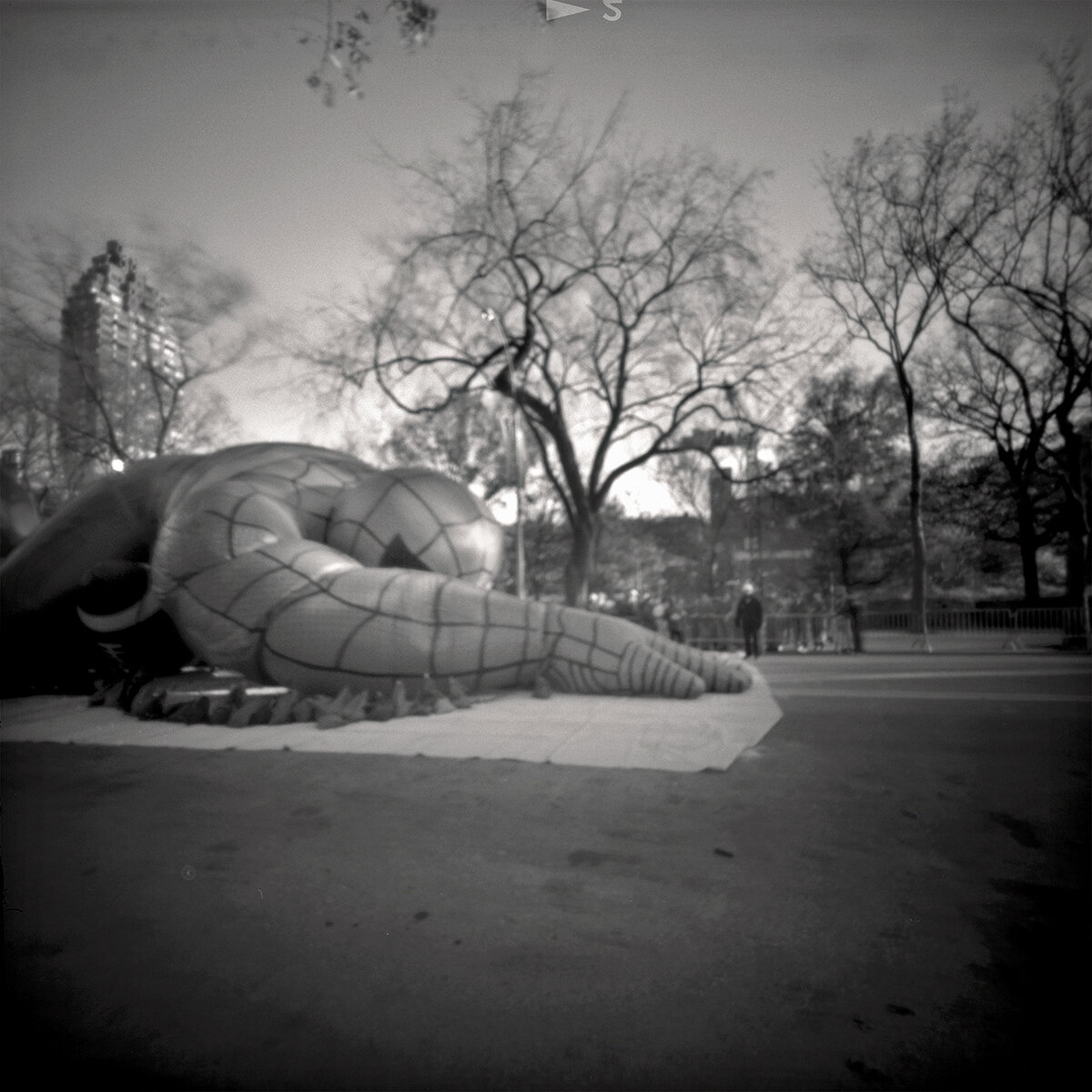
It’s been a while since my last online sale, but for the month of June I’m making eight of my New York City pinhole photographs available for purchase—signed, archival giclée prints in your choice of size. Scroll down for purchasing information and for back stories on the photos.
5 x 5 inches – $150
12 x 12 inches – $300
24 x 24 inches – $650
36 x 36 inches – $1200
Order by June 15 and receive 10% off any print size. All orders will be securely shipped by mid-July.
Thank you for supporting this work!
Stefan



Purchasing Photographs
1) Place Your Order
Please complete and submit the form below, indicating your name, preferred print size(s), and your shipping/delivery address. I’ll get back to you right away with payment instructions, which will be in two parts: print payment and shipping payment. Remember that print payments made by April 15 receive 10% off any print size!
2) Payments
Payment is in two parts:
Print payment, including NYS sales tax and mailing costs, is due now to reserve your photo. I will send you payment instructions for Venmo, PayPal, or Zelle as soon as I receive your order.
Shipping payment will be billed separately once your print is ready, based on size and location. I’ll make sure it’s packed securely and affordably. If you're in NYC, I’ll hand-deliver when possible to save you the shipping cost.
2) Payments
As soon as I receive your order, I’ll contact you with the payment amount and instructions. Payments may be made by Venmo, PayPal, or Zelle.
The Photographs

Jane's Carousel, 2014
Jane's Carousel, 2014
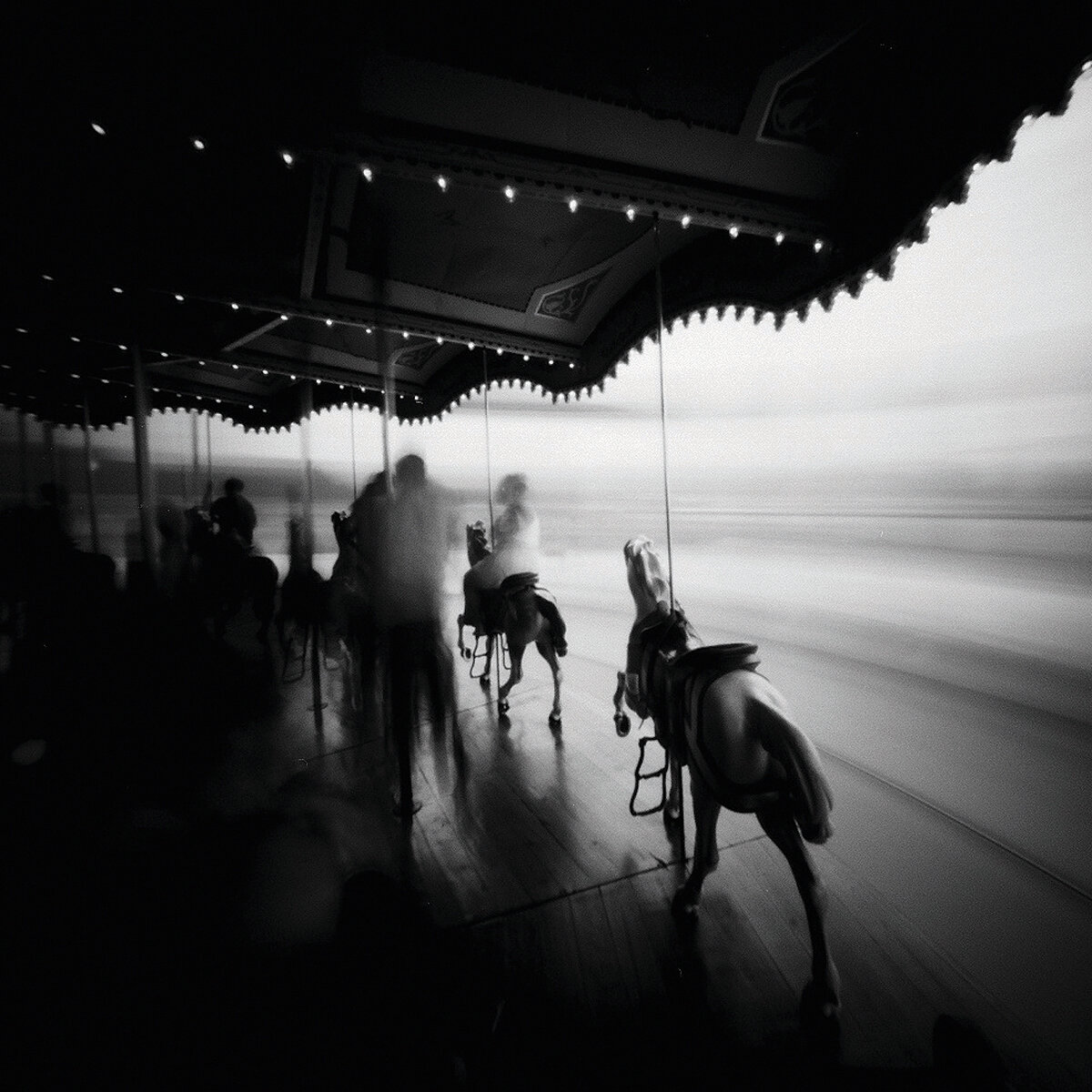
Jane’s Carousel was a fitting subject for my Pinhole NY project—a years-long meditation on time and space using a lensless cardboard box camera. But beyond the obvious metaphor, which Joni Mitchell captured so beautifully in “The Circle Game”, who doesn’t love an old-fashioned carousel and the bright, brassy sound of a band organ?
Built in 1922, the carousel was originally located in Youngstown, Ohio. After the park closed, it was purchased at auction by Jane Walentas, who restored it over 22 years in her Dumbo studio—a stone’s throw from both my own studio and Fulton Ferry Landing, where Walt Whitman’s poem “Crossing Brooklyn Ferry” was born. Today, the carousel lives in a stunning glass pavilion designed by Pritzker Prize–winning architect Jean Nouvel.
When I went to photograph it in 2014, maybe for the third time, I set up my tripod outside the roped-off carousel. My earlier images were decent, but not especially surprising, and I wasn’t sure what I’d do differently this time. Then I remembered something a photographer friend once told me: If your photo isn’t good enough, you’re not close enough. So I bought a few tickets and climbed aboard with my son, Lee. I took about eight exposures—and bingo.
We’re captive on the carousel of time.
Manhattan Bridge, 2014
Manhattan Bridge, 2014
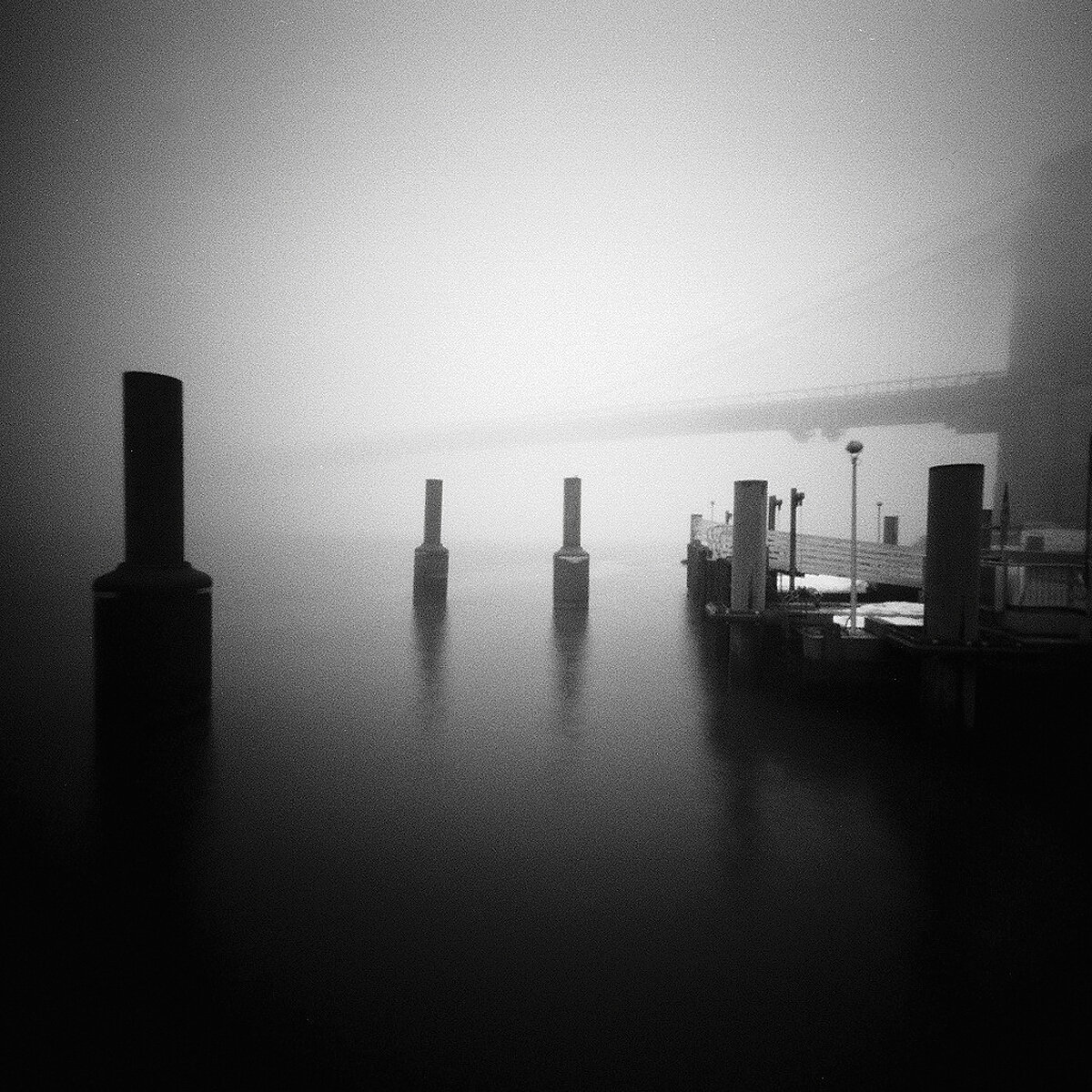
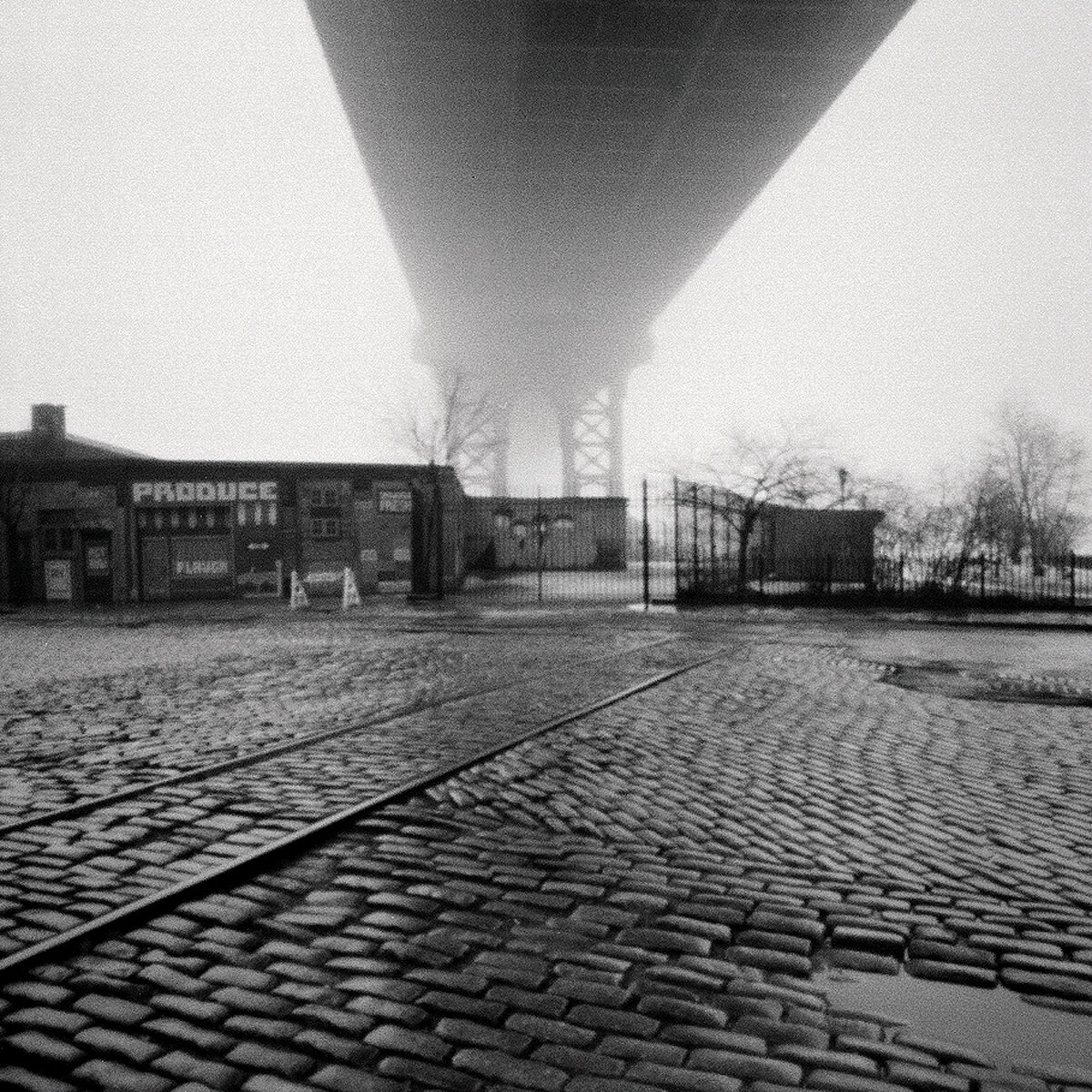
One February morning in 2014, I arrived at my Dumbo studio to find the East River covered in what’s affectionately called pea soup fog. I had business work waiting, but I couldn’t pass up the opportunity to take some photos. I grabbed my pinhole camera, tripod, and two rolls of film, and headed down to the water.
My most successful images often come from a series of exposures. Since my pinhole camera has no viewfinder, I never really know what a photo will look like. Add to that how the camera distorts space, light, and time—and all I can do is set my conditions as carefully as possible, take multiple shots, and hope one of them is a keeper.
That morning, I took 24 exposures—mostly variations on the very subtle two scenes below in comments. But the two fog images in this sale, one of the Brooklyn Bridge and one of the Manhattan Bridge, were each captured in single shots. In both cases, I got lucky, which is generally how it works with pinhole photography.
Picking up newly developed film always feels like unwrapping a present: I never know what I’m going to get, or whether I’ll like what I see. Sometimes it takes weeks and multiple viewings to really see what’s there.
Not this time. Bingo! Not just once, but twice.
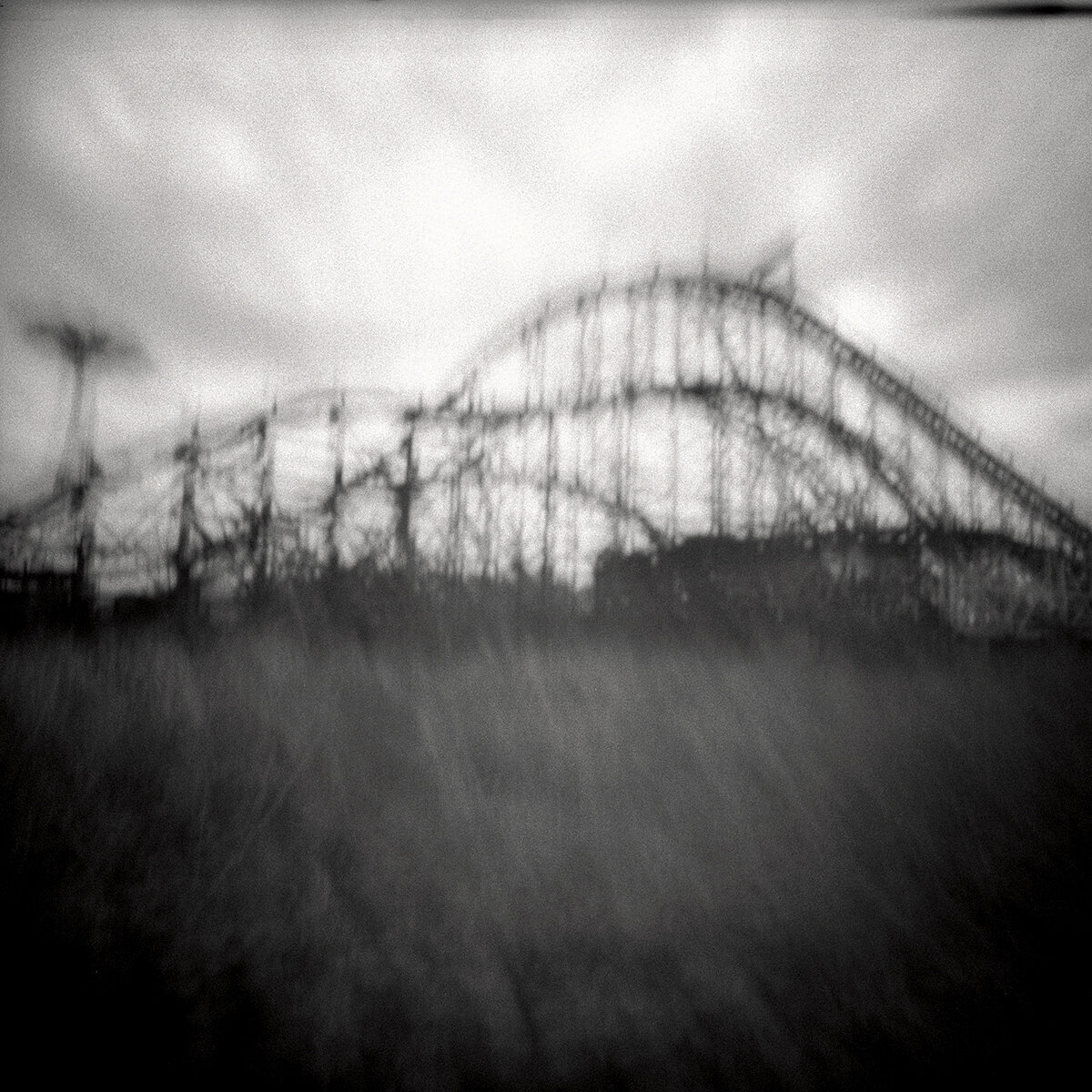
Thunderbolt Roller Coaster, 1992
Thunderbolt Roller Coaster, 1992
Sometimes it’s breaking the rules in art—intentionally or by accident—that produces the best results. Such was the happy case with my Thunderbolt roller coaster photo.
Pinhole photography typically requires long exposures—ranging from half a second on a bright, sunny day (using fast film, not paper), to five seconds on an overcast day, to ten minutes at sunset. Because of this, one of my own rules is to always use a tripod. But early on in my pinhole career, I didn’t own a tripod but would steady the camera by bracing it against a wall or some other fixed object to keep it from moving.
That’s what I did in 1992 when I visited Coney Island with a friend and took several photos of the old Thunderbolt roller coaster—immortalized in Woody Allen’s Annie Hall: “My analyst says I exaggerate my childhood memories, but I swear, I was brought up underneath the roller coaster in the Coney Island section of Brooklyn.”
At the time, the Thunderbolt stood fenced off in a field of weeds, slowly rotting after being shut down in 1982. Reaching through the fence, I steadied the camera by pressing it against a wooden post. But I must have nudged it during the exposure, because the resulting image was badly blurred.
Normally, that kind of blur would disqualify a photo. But in this case, it was perfect for the subject—jerky and noisy, like the roller coaster itself. Bingo. More than thirty years later, this image remains one of my favorites from a long career of engaging with the game of chance that is pinhole photography.
Brooklyn Bridge, 2014
Brooklyn Bridge back story:
One February morning in 2014, I arrived at my Dumbo studio to find the East River covered in what’s affectionately called pea soup fog. I had business work waiting, but I couldn’t pass up the opportunity to take some photos. I grabbed my pinhole camera, tripod, and two rolls of film, and headed down to the water.
My most successful images often come from a series of exposures. Since my pinhole camera has no viewfinder, I never really know what a photo will look like. Add to that how the camera distorts space, light, and time—and all I can do is set my conditions as carefully as possible, take multiple shots, and hope one of them is a keeper.
That morning, I took 24 exposures—mostly variations on the very subtle two scenes below in comments. But the two fog images in this sale, one of the Brooklyn Bridge and one of the Manhattan Bridge, were each captured in single shots. In both cases, I got lucky, which is generally how it works with pinhole photography.
Picking up newly developed film always feels like unwrapping a present: I never know what I’m going to get, or whether I’ll like what I see. Sometimes it takes weeks and multiple viewings to really see what’s there.
Not this time. Bingo! Not just once, but twice.

A free copy of my Pinhole NY zine: Lo-fi Photographs of the Great Metropolis comes with any print purchase. Or, buy it separately for $20 plus sales tax and shipping.
Pinhole New York
I have been taking pinhole photographs of New York City since 1991. My images have been exhibited at the Alan Klotz Gallery and Soho Photo Gallery in New York and in group shows juried by, among others, Larry Gagosian and Molly Barnes. In addition to being in private collections throughout the US, Europe, and Japan, my photos are included in the acclaimed book Out of Focus: Pinhole Cameras and Pinhole Photographs; film and television productions such as Billions and Creed; and The Clocktower Restaurant at Ian Schrager’s New York EDITION hotel.